


Crafting compelling narratives
Threadline Media is an independent editorial and audio production practice helping cultural institutions, public bodies and universities turn complex ideas, research and public-interest work into clear, engaging stories. I provide research, writing, editorial development and podcast/radio production, with a particular focus on factual storytelling and public engagement.
What we do
Threadline is an independent editorial and audio production practice led by David Gordon. It is built for organisations with valuable knowledge to communicate, recurring content needs and limited in-house capacity—particularly cultural and heritage organisations, public bodies and agencies, educational organisations, purpose-led businesses, and independent podcast and media producers.
Threadline provides research, scriptwriting, editorial support, podcast and radio production, and the development of substantial long-form digital content. We are particularly suited to work requiring intellectual rigour, reputational sensitivity and a consistent editorial voice.
Alongside commissioned work, Threadline develops original history and cultural programming for public audiences. This work creates intellectual property and builds a direct audience while demonstrating Threadline’s approach: rigorous research, accessible writing, humane interviewing and thoughtful audio production.
How Podcasting Can Help Heritage Organisations Engage the Public
Heritage organisations are custodians of remarkable knowledge, memories and human experiences. Yet much of this wealth remains confined to exhibitions, archives, catalogues, reports or the expertise of staff. A podcast can bring this material into public life, presenting it in a form that is intimate, accessible and capable of reaching far beyond the walls of a museum, historic house, archive or heritage centre.
The particular power of podcasting lies in the human voice. Heritage is not merely a collection of objects and dates; it concerns the experiences of people. When listeners hear an archaeologist describe the moment an artefact was unearthed, a conservator explain the marks on an object, or a local resident remember a vanished street, the subject acquires an immediacy that written interpretation can struggle to provide. The audience is invited into a conversation rather than simply presented with information.
This makes podcasting especially effective for telling the stories surrounding a collection. Exhibition labels must be concise, while guided tours are constrained by time, space and staff availability. A podcast episode can explore uncertainty, disagreement and historical context. It can ask why an object matters, how its interpretation has changed, whose perspectives were previously overlooked and what remains unknown. When carried by a clear narrative and an engaging voice, complexity need not make heritage less approachable. It can make it more compelling.
Podcasting also allows an organisation to establish an ongoing relationship with its audience. A single exhibition or anniversary may provide the starting point, but a sustained series can return to a collection from different angles, follow a restoration or archaeological project as it develops, respond to public questions and introduce listeners to the people whose work normally happens out of view. Each episode becomes part of an accumulating digital resource rather than a piece of publicity that disappears once a campaign ends.
This engagement extends beyond the physical visit. People may listen before travelling, while exploring a site or long after returning home. Others may never be able to visit because of geographic, financial, physical or personal circumstances. Audio allows an organisation to reach people in their homes, cars and workplaces, or during an ordinary walk. A podcast therefore does more than promote a destination: it provides meaningful remote access to its intellectual and cultural life.
The format can also deepen public participation. Oral-history interviews, community discussions and listener questions allow people to contribute to heritage rather than merely consume it. This is particularly important when interpreting living memory, contested histories or places shared with surrounding communities. Personal testimony must be approached ethically, with informed consent and appropriate care, but it can challenge the assumption that expertise flows in only one direction. Institutional knowledge and lived experience can illuminate one another.
For organisations with limited internal capacity, podcasting also offers considerable flexibility. A worthwhile series does not require celebrity presenters or an elaborate studio. A well-researched and carefully edited conversation can carry greater value than an expensive production without a clear purpose. Episodes might accompany an exhibition, anniversary, restoration project or archaeological season, or begin with a single item from a collection.
The underlying research can also support articles, educational resources, newsletters, transcripts and short-form digital content. This makes podcasting part of a wider editorial programme rather than an isolated product. One carefully planned recording can generate several useful public resources, provided that each is adapted for its medium rather than reproduced mechanically.
It is nevertheless important to distinguish between producing a podcast and simply recording conversations. Strong heritage audio requires an editorial purpose. Each episode should understand its intended audience, the questions it wants to answer and why the story benefits from being heard rather than merely read. Clear sound, disciplined editing and a dependable publishing rhythm demonstrate respect for the listener. Transcripts improve both accessibility and discoverability, while introductions should explain specialist language without condescending to the audience.
Editorial judgment becomes especially important when organisations address histories of violence, inequality, empire, religion, class or institutional abuse. Podcasting can create space for voices previously excluded from official interpretation, but participation should not be used to disguise institutional evasion or manufacture a false balance. A trustworthy series can acknowledge gaps in the record, distinguish evidence from interpretation and explain disagreements honestly. The informality of audio should strengthen accountability rather than weaken it.
The public value of a heritage podcast should consequently be assessed more broadly than through download figures alone. Completion rates, returning listeners, audience questions, educational use, community participation and the continued relevance of older episodes may reveal more about its success. A modest but deeply engaged audience can be more valuable than a larger one that encounters an episode only briefly.
For heritage organisations, the strongest podcast is not simply another promotional channel. It is a continuing act of interpretation: a way to share knowledge, open collections, record living memory and build a durable relationship with the public.
Threadline helps organisations develop this work from its earliest editorial stages through to publication. This can include concept development, historical and contextual research, scripting, interview preparation, recording, editing, transcripts and the creation of related long-form digital content. The aim is not merely to produce individual episodes, but to help organisations turn their knowledge into thoughtful, sustainable public programming.

Podcast & radio production
From concept to final mix, we produce high-quality audio content, including podcasts and radio programmes, ensuring captivating soundscapes and clear narratives.

Research & editorial development
We delve deep into subjects, conducting thorough research and developing compelling editorial strategies to bring your stories to life.
Scriptwriting & copywriting
Whether for audio, video, or web, we craft engaging scripts and persuasive copy that capture attention and communicate your message effectively.


Documentary & factual storytelling
We specialise in developing and producing factual stories, bringing depth and insight to documentaries for various platforms.
"David's ability to weave intricate narratives into compelling audio is truly exceptional. His work for our project exceeded all expectations, delivering both depth and impact."

Selected work
The Smiley Tapes
Short film / creative media project
Whatever Happened to Sarah Mitchell on Misery Hill
Radio play
Róisín’s Wake
Scriptwriting
Creative Digital Media, Dublin College Dun Laoghaire
Educational project
A satisfied client

Coming Autumn 2026
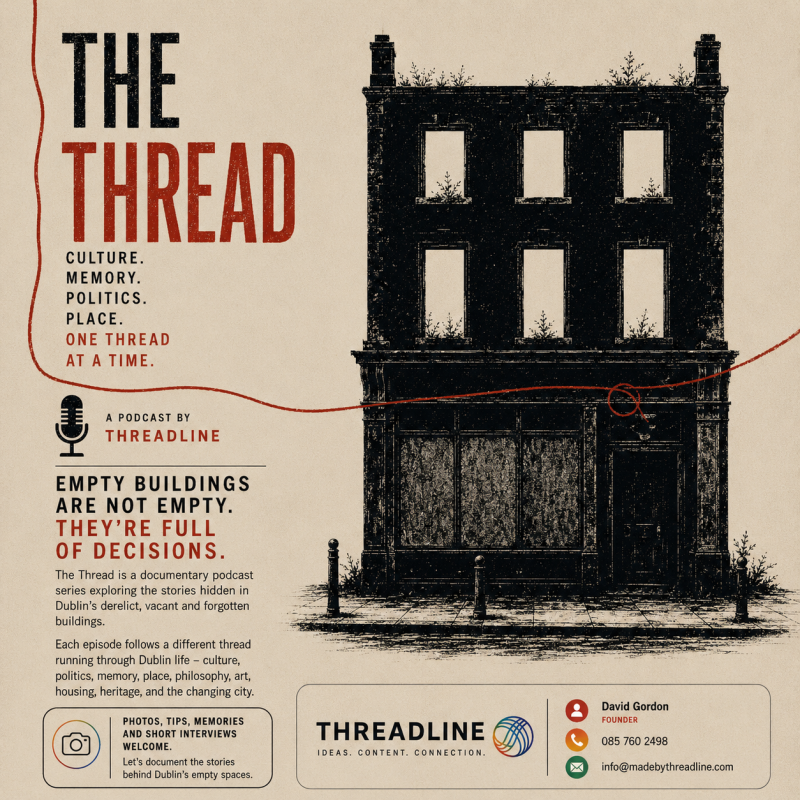
View our latest work
Discover our collection of creative work and visual projects. Each piece showcases our attention to detail and commitment to delivering results that exceed expectations.
About
I’m David , a creative producer, writer, researcher, and editorial maker based in Dublin.
My work sits across audio, editorial, factual storytelling, cultural writing, and development. I’m interested in thoughtful, idea-led projects: stories with a clear point of view, strong structure, emotional intelligence, and a sense of purpose.
Through Threadline, I develop and shape creative work across podcasting, radio, documentary-style production, research, copy, scriptwriting, and visual storytelling. My background in Creative Digital Media has given me experience across radio production, script development, editing, image processing, media analysis, and sound-led production.
I’m drawn to work that is precise, human, and carefully made - work that finds the thread running through an idea and brings it into focus.